LA GALLERIA DELL' OCA
INSTITUTION
An educational board game that turns art history into physical play for children aged 6–12, using Arduino and RFID technology embedded in a 3D-printed goose figure
Politecnico di Milano
YEAR
2024
ROLE
· 3D Modeling · Arduino Programming
TEAM
· Beyza Eylül Ergün
· Aranza Alcalá
An educational board game that turns art history into physical play for children aged 6–12, using Arduino and RFID technology embedded in a 3D-printed goose figure

The Challenge

The Challengue
Traditional educational content often struggles to maintain children's attention and curiosity.
Our challenge was to create a learning experience that felt playful and rewarding while introducing complex concepts such as artistic movements, historical context, and visual culture.




The Solution
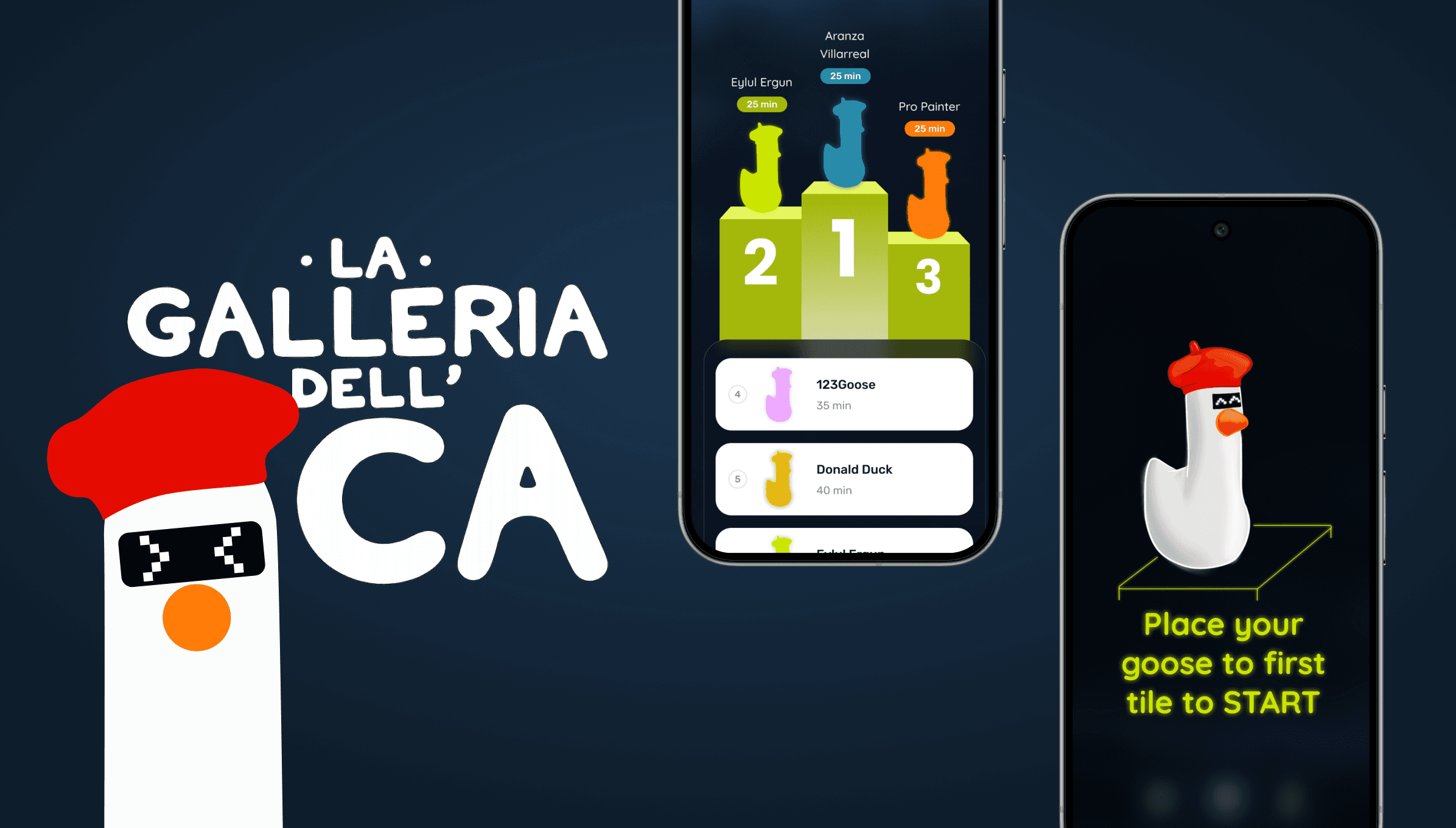
We designed La Galleria dell'Oca as an educational board game that turns art history into physical play for children aged 6–12. Inspired by the traditional Italian "Gioco dell'Oca," players move a goose figure across illustrated tiles — each one triggering a story, fact, or mini-challenge through Arduino and RFID technology embedded in the figure itself.
My contribution: I co-developed the game concept and interaction logic, designed the visual language of the board tiles, and created the goose itself from concept to prototype. Using Fusion 360 and Rhino, I modeled and prepared the 3D-printable enclosure that houses the electronics, and contributed to the Arduino implementation, RFID integration, wiring, soldering, and assembly — ensuring the physical and digital components worked together as a cohesive learning system.
Outcome
La Galleria dell'Oca demonstrates how physical computing can transform educational experiences into playful and engaging learning systems. By combining RFID technology, Arduino integration, storytelling, and game mechanics, the project creates an interactive way for children to explore art history through discovery, participation, and hands-on learning.
This will hide itself!
LA GALLERIA DELL' OCA
INSTITUTION
An educational board game that turns art history into physical play for children aged 6–12, using Arduino and RFID technology embedded in a 3D-printed goose figure
Politecnico di Milano
YEAR
2024
ROLE
· 3D Modeling · Arduino Programming
TEAM
· Beyza Eylül Ergün
· Aranza Alcalá
An educational board game that turns art history into physical play for children aged 6–12, using Arduino and RFID technology embedded in a 3D-printed goose figure
The Challenge
The Challengue
Traditional educational content often struggles to maintain children's attention and curiosity.
Our challenge was to create a learning experience that felt playful and rewarding while introducing complex concepts such as artistic movements, historical context, and visual culture.
The Solution
We designed La Galleria dell'Oca as an educational board game that turns art history into physical play for children aged 6–12. Inspired by the traditional Italian "Gioco dell'Oca," players move a goose figure across illustrated tiles — each one triggering a story, fact, or mini-challenge through Arduino and RFID technology embedded in the figure itself.
My contribution: I co-developed the game concept and interaction logic, designed the visual language of the board tiles, and created the goose itself from concept to prototype. Using Fusion 360 and Rhino, I modeled and prepared the 3D-printable enclosure that houses the electronics, and contributed to the Arduino implementation, RFID integration, wiring, soldering, and assembly — ensuring the physical and digital components worked together as a cohesive learning system.
Outcome
La Galleria dell'Oca demonstrates how physical computing can transform educational experiences into playful and engaging learning systems. By combining RFID technology, Arduino integration, storytelling, and game mechanics, the project creates an interactive way for children to explore art history through discovery, participation, and hands-on learning.
This will hide itself!
LA GALLERIA DELL' OCA
INSTITUTION
An educational board game that turns art history into physical play for children aged 6–12, using Arduino and RFID technology embedded in a 3D-printed goose figure
Politecnico di Milano
YEAR
2024
ROLE
· 3D Modeling · Arduino Programming
TEAM
· Beyza Eylül Ergün
· Aranza Alcalá
An educational board game that turns art history into physical play for children aged 6–12, using Arduino and RFID technology embedded in a 3D-printed goose figure
The Challenge
The Challengue
Traditional educational content often struggles to maintain children's attention and curiosity.
Our challenge was to create a learning experience that felt playful and rewarding while introducing complex concepts such as artistic movements, historical context, and visual culture.
The Solution
We designed La Galleria dell'Oca as an educational board game that turns art history into physical play for children aged 6–12. Inspired by the traditional Italian "Gioco dell'Oca," players move a goose figure across illustrated tiles — each one triggering a story, fact, or mini-challenge through Arduino and RFID technology embedded in the figure itself.
My contribution: I co-developed the game concept and interaction logic, designed the visual language of the board tiles, and created the goose itself from concept to prototype. Using Fusion 360 and Rhino, I modeled and prepared the 3D-printable enclosure that houses the electronics, and contributed to the Arduino implementation, RFID integration, wiring, soldering, and assembly — ensuring the physical and digital components worked together as a cohesive learning system.
Outcome
La Galleria dell'Oca demonstrates how physical computing can transform educational experiences into playful and engaging learning systems. By combining RFID technology, Arduino integration, storytelling, and game mechanics, the project creates an interactive way for children to explore art history through discovery, participation, and hands-on learning.
This will hide itself!